
Interview: Geothermal Development in Indonesia - Vicki Ray Chandra
An Interview with Vicki Ray Chandra on Geothermal Resources, Political Bottlenecks, and the Future of Clean Power Across Indonesia’s Fractured Grid

This week, I’m publishing an interview transcript—something new for this platform, and possibly the first of several. The aim is to bring in grounded insight from professionals working in the field. I will be diving more into the topics discussed here in the weeks ahead. Subscribe for that.
If there’s someone you’d like to hear from and they’d be open to a conversation, let me know.
Here is the enhanced transcript.
J: Great. Thank you for coming to the show today. For my audience, this is Vicki Ray Chandra. He’s an Indonesian geothermal geologist with over a decade of experience in geothermal fields across the globe. He’s published on 3D geothermal modeling1 and drilling optimization2, as well as much more.
He’s currently a senior geologist with Geoenergis3, a Jakarta-based geothermal consulting firm that supports developers at every stage of geothermal projects. It’s great to be able to talk to you. I’d like to start, if I can, with a discussion of technology and geology—the state of things in Indonesia.
I’m curious if you can elucidate a little bit. How far has Indonesia gone in tapping into its conventional geothermal4 potential? Is it still early, or is conventional geothermal near maturity in terms of getting out the energy that there is? How much of it is a matter of exploration that still needs to be done?
V: Thanks, Jim, for having me, and thanks for the introduction. Indonesia is now focused on exploring and exploiting high-temperature geothermal systems. When you say “conventional,” I think of hydrothermal systems—reservoirs containing hot fluids that we can exploit as hot water or steam.
We’ve been producing from high-enthalpy reservoirs5 since the early 1980s—about forty-five years—but that represents only 9–10 percent of the total conventional potential. The government is now shifting attention from high-enthalpy to low- and medium-enthalpy resources6, still conventional but at lower temperatures. That is where we expect growth in the coming years.
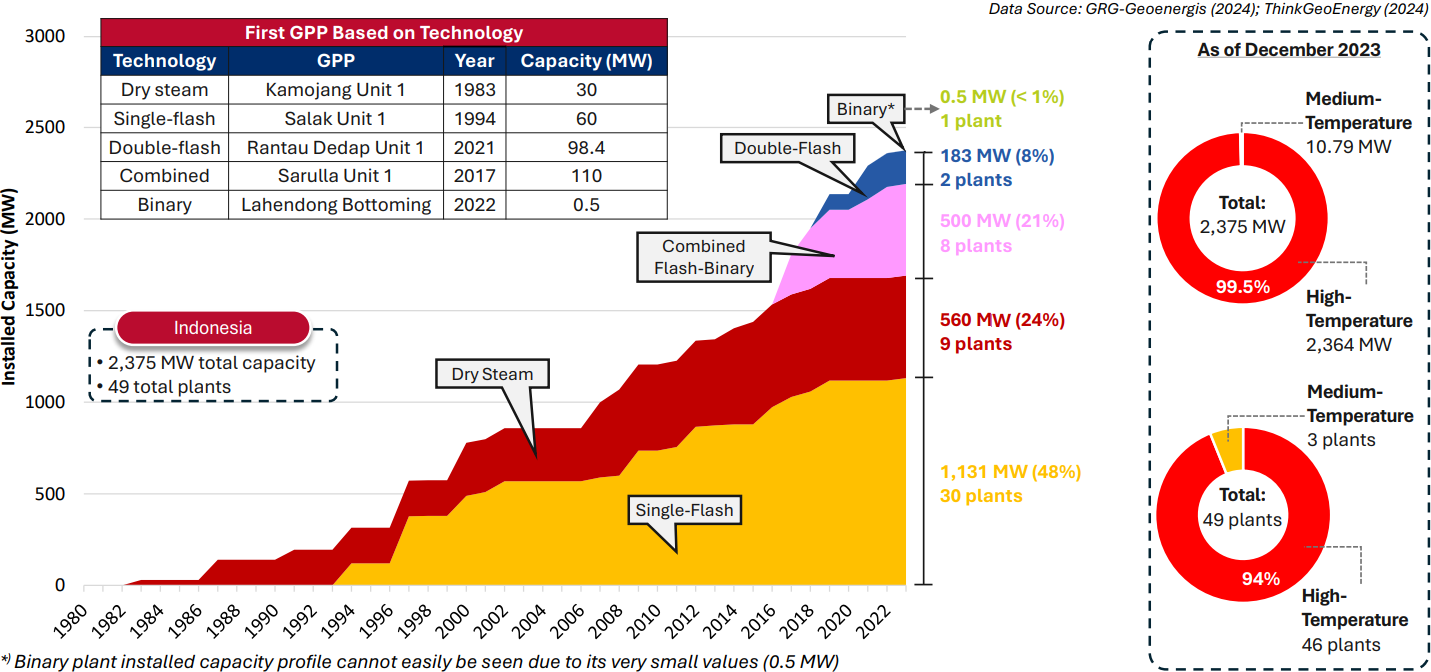
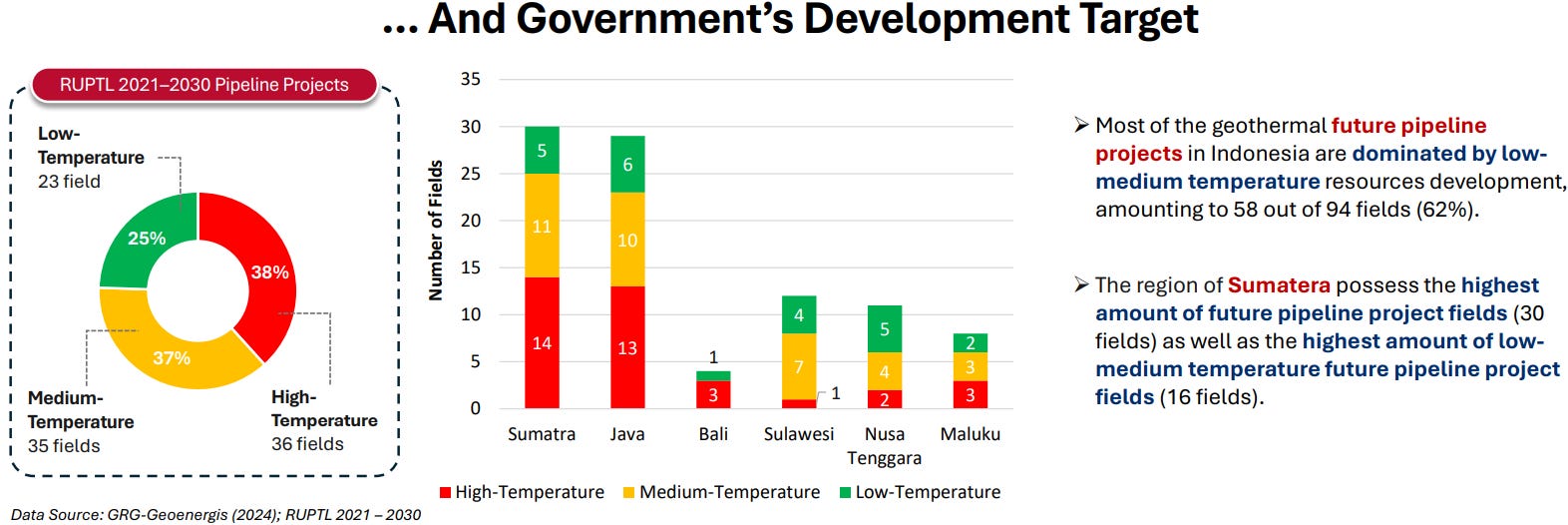
J: How does that conventional potential compare with emerging technologies such as enhanced geothermal systems? Do you see EGS7 or other unconventional approaches having a place in Indonesia soon?
V: The lowest-hanging fruit is still conventional—sink a well into a hydrothermal reservoir and put a few megawatts on line. I do believe that in five to ten years we’ll start to see EGS or even more advanced concepts, but not immediately.
J: Are there other unconventional technologies—beyond EGS—that you think could work in Indonesia?
V: They’re being proven in the US, Europe, and elsewhere, but I haven’t seen signs they’ll be adopted here quickly. Eventually, yes, but not in the near term.
J: Let’s talk about Indonesian geography. How does it differ from places where you’ve worked, such as the Middle East?
V: Indonesia is an archipelago of thousands of islands—five or six of them very large—and it sits on active plate boundaries. Subduction of the Pacific and Indian-Australian plates beneath the Eurasian plate drives volcanism from the west coast of Sumatra through the south coast of Java, curving south of Flores. In the far west there’s also a collision between the Eurasian and Pacific plates that triggers magmatism, though not as extensively as in Sumatra and Java. Kalimantan (Borneo) is relatively stable. There is potential there but not that big.
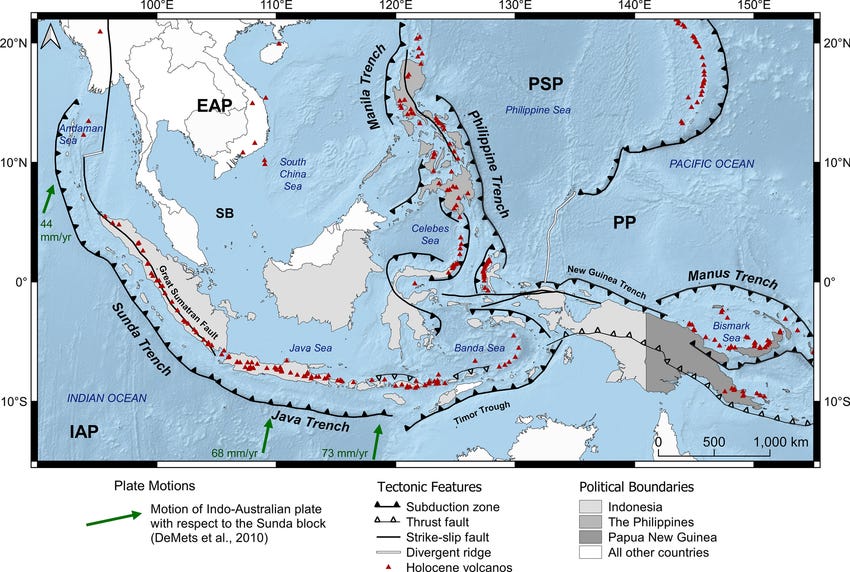
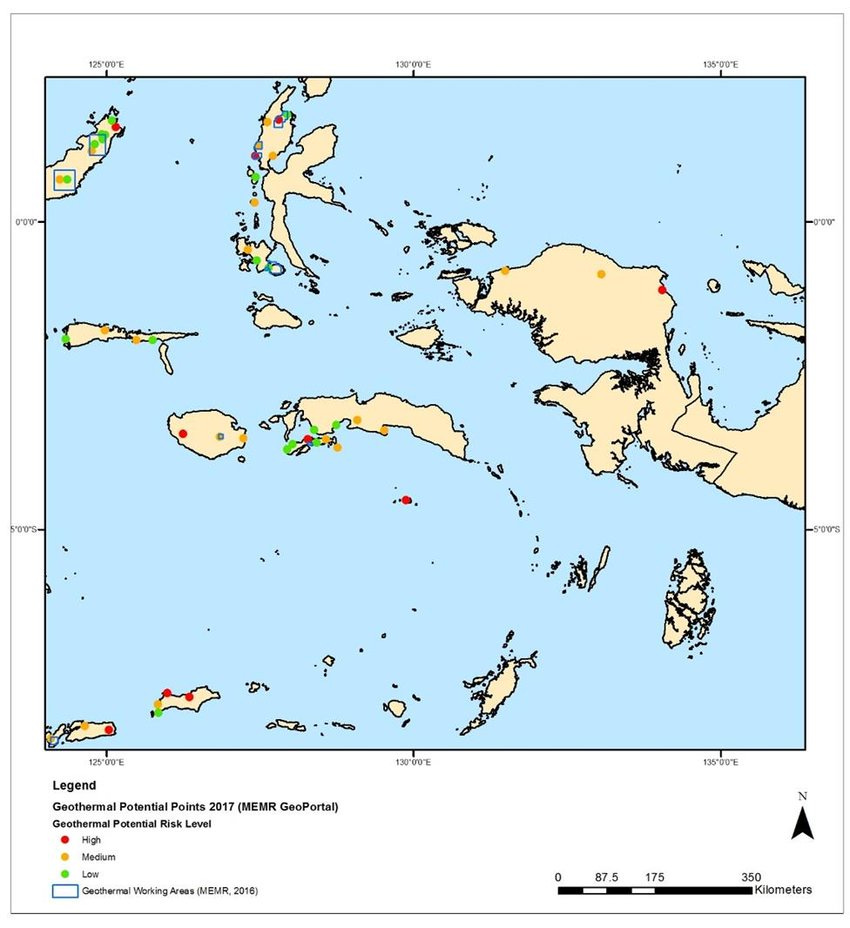
In Halmahera in the east, we see some hotspots there and prospective areas that are being explored by developers. We also notice some hotspots in parts of Papua—but they are smaller. All this tectonic activity gives us many volcanoes and therefore abundant geothermal systems. A Geological Agency study puts conventional potential at about 23 GW8.
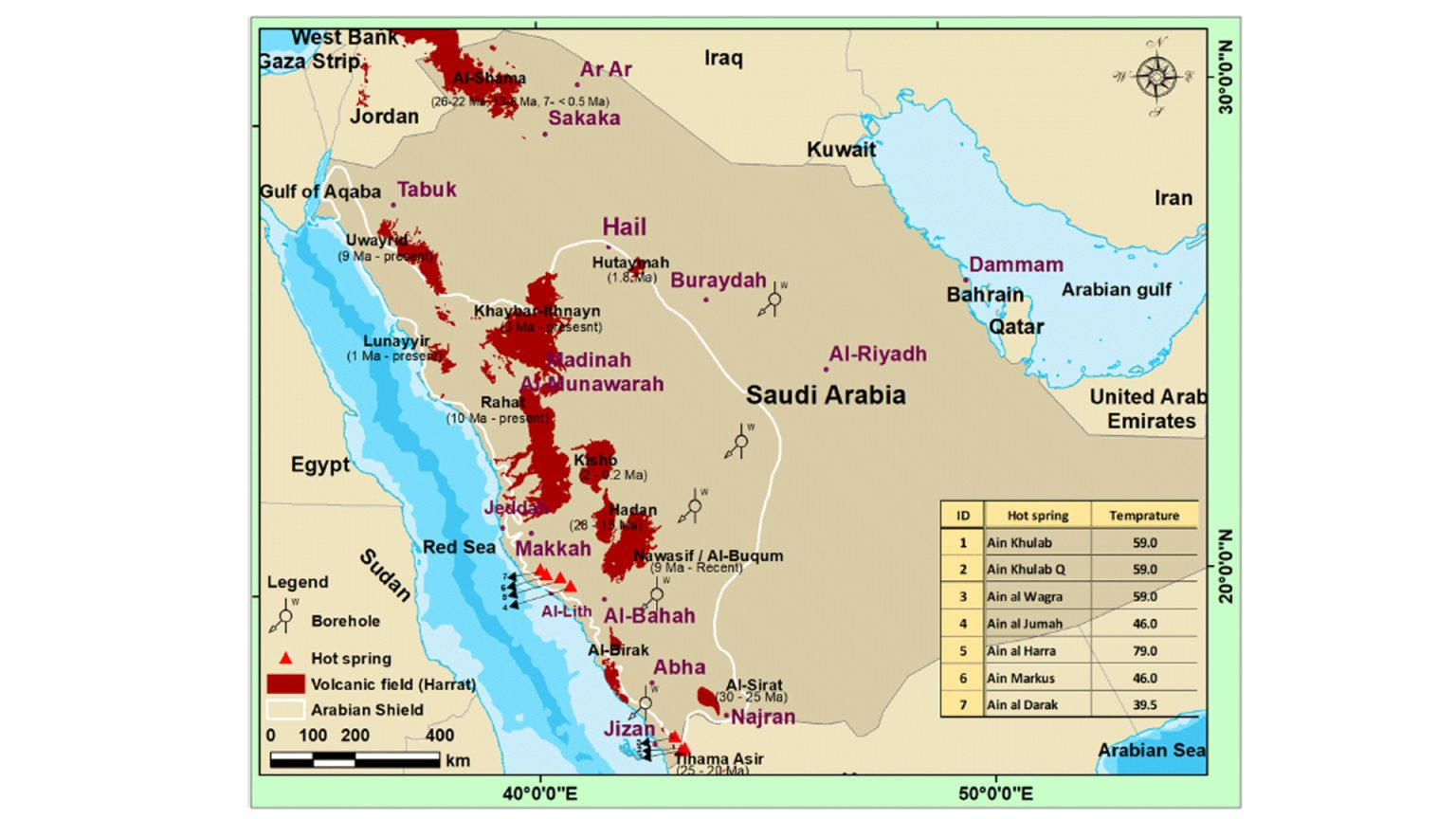
By contrast, the Middle East where I worked is tectonically calmer. The main boundary there is the Red Sea rift, a triple junction with the Gulf of Aden and East African rift. Kenya and its neighbors produce geothermal from that setting. In the Middle East, the rifting in the Red Sea has triggered some magmatism in that area but based on our field observation volcanism is no longer there. We believe there is still heat underneath those volcanoes that would be the source that warms the aquifers in western Saudi Arabia and Yemen. The geothermal systems that develop well there are the hot-sedimentary-aquifer systems, with heat also coming from the decay of certain radioactive minerals. This is very different from Indonesia’s highly volcanic systems, where systems are highly connected to volcanic activity.
J: How do those geological differences translate into project design?
V: With large volcanoes you get elevated heat at shallow depth, so the reservoirs are high-enthalpy and accessible with current drilling. You have a high quality of reservoir, but on the surface you have steep terrain. So there are difficulties with road construction and production facilities. That is an additional challenge, you have difficulties at the surface but good quality resource subsurface.
J: On that point, I am curious about land classification in Indonesia. Many Indonesian volcanoes sit inside national parks or national forests. How big a barrier is that legal classification?
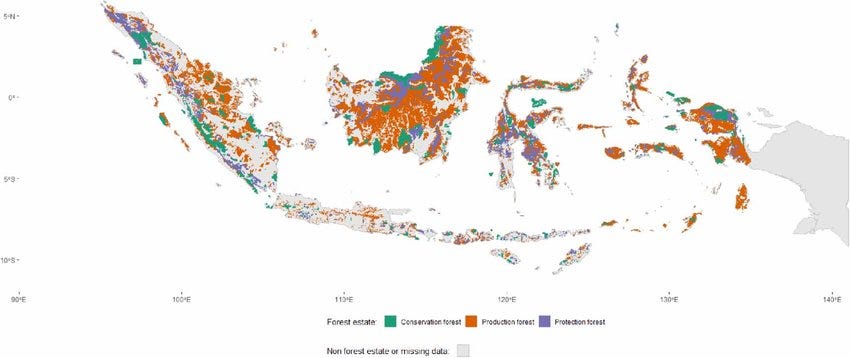
V: Yeah, most of the volcanoes, specifically the peaks, are national park areas. It is very hard to touch, even doing geoscience surveying is difficult. In geoscience survey we do not change surface conditions but still have difficulties conducting them, even more for drilling and construction. We can access beyond that area, but at some point we have to work with ministry of environment and forest because most of the resources will be underneath protected forest. This is a challenge. You have to comply and get proper permits, notably a borrow-use permit (IPPHK9). This prolongs the development timeline but is still doable. This license needs months, sometimes a year or two. This is another reason permit timelines are longer here. Beyond that region, access is easier, but you have to deal with the people living in the area.
J: Yeah, how does local politics and adat10 customary law intersect with geothermal projects?
V: Indonesia is decentralized. You deal with the central government, the provincial and district governments, and the traditional leaders—the kepala suku or kepala adat11. A local government approval does not guarantee a blessing from the tribal head. You need approval from both to access their land. This is different from my experience in the Middle East, where a thumbs-up from the central government makes access easy.
J: I imagine each island is different, what are typical delays like for negotiations with kepala adat or kepala suku?
V: Yeah, Indonesia is made of thousands of islands with different cultures and religions. The approach is different for each. For example, one Sumatra project needed six or seven years to gain community consent for the first exploration well, while a neighboring area took only two years. On Flores, local belief forbade selling land, so after 3 or 4 years we switched to renting the land rather than acquiring it. There is no one-size-fits-all solution.
J: Could you outline the typical development sequence and where delays occur beyond what we have discussed already?
V: After receiving an exploration license we meet local communities and governments and run geoscience surveys. Those are straightforward because we don’t alter the surface. Then we build a resource model and plan drilling; that’s when serious engagement with communities, local government, and forestry officials begins. When permits are secured, we start to acquire land, build roads and well pads, and bring in the rig. Each step has its own challenges.
J: Before we move on, which factor usually turns out to be the bigger bottleneck—unique geology or the legal and political constraints?
V: It depends on the island, East and West have different challenges. On Java the demand is high. But most electricity is supplied by coal. Geothermal struggles to compete with coal which has costs much lower than geothermal, with producers often sitting on the government side. That is the situation in Java and some parts of Sumatra. In eastern Indonesia the challenge is the quality of resource and resource uncertainty. It is hard to find good quality resource, in terms of temperatures, permeability and benign fluid. Sumatra sits in between; projects there face both technical and political issues.
J: That is a good map. I would like to move into the market. I know you have experience with PLN projects, and more recently with IPP12 projects. What are the strengths and weaknesses of private industry and PLN13?
V: In the early days—projects from the 1980s into the early 2000s—developers produced only steam and sold it to PLN, which built the power plant and transmission lines. The steam is what is sold rather than electricity. I have not heard about this happening in the modern day. Now IPP converts the steam to electricity and sells it directly to PLN. I believe the private sector is better to develop these resources. PLN, as a big company, has large coal and hydro plants as the main focus of their business. I believe the private sector is better suited to develop these geothermal projects and PLN usually seeks partners in this.
J: It seems like over the course of your career, PLN has made it easier to sell electricity directly to PLN, is this a trend you see continuing? What is the outlook in terms of selling electricity in Indonesia?
V: The government sets geothermal tariffs by presidential decree, calculating different rates for different regions according to their formula14. That involvement yields a healthy tariff to attract investment. Having a single off-taker, PLN, has pros and cons. Today nearly every project sells electricity; the steam-sale model has disappeared.
J: Are current tariffs high enough to draw the investment to geothermal in Indonesia?
V: The tariff set by the government right now is not high enough to attract significant investment. They are thinking about ensuring profit for developer and PLN. I think the number is not generous but still doable in the long run. Over, say, 20- or 30-year horizon a developer can make a reasonable profit, but in the short run the upfront risk and cost remain a challenge for investors.
J: Where are the regions underrated relative to their potential?
V: Eastern Indonesia is underrated definitely. It’s hard to find high-quality reservoirs there, the terrain is rugged, and infrastructure—even transmission—is sparse. But the Government has set a high tariff and investors are coming. There are companies doing exploration in Sulawesi, Flores and Halmahera.
J: How does transmission factor into the island picture?
V: Java already has plenty of coal-fired capacity, so geothermal power can face curtailment during oversupply. The government is letting the coal plants to be retired, but at a slow rate. The main grid runs from West Java to East Java and even connects to Bali. West Nusa Tenggara has subsea links. Flores and the smaller eastern islands lack any connection to the main grid; building a sub-transmission line is capital-intensive. This is one of the regions where geothermal is relatively undeveloped. Sumatra has three major transmission lines: North Sumatra, Central Sumatra and South Sumatra. PLN still needs additional generation there, so geothermal projects fare better.
J: Could a geothermal project work on an isolated island like Flores without interconnecting grids?
V: Personally I doubt it. Demand is small and the economics are tough. PLN would need to build the transmission, and that’s hard to justify for a small load.
J: What trends do you see in grid construction? Do you expect PLN to expand and interconnect island grids?
V: I’m not a transmission engineer, but in my part of Sumatra we still have blackouts that last days, so the network is clearly weaker than Java’s. That under-supply is one reason PLN remains interested in geothermal there.
J: How do Indonesian risks compare with Saudi Arabia, where you’re also active?
V: In Saudi Arabia geothermal competes with very cheap oil-fired power; fossil electricity is affordable and geothermal resources are modest, so the LCOE is high. But, the Saudis are assessing prospects again and Oman is screening abandoned oil and gas wells for co-generation of electricity and exploring promising regions; the whole region is moving toward geothermal, but at different speeds.
J: What have you learned from other regions?
V: I just came back from Colombia. They have the expertise and resources; they’re waiting for final government approvals, and once they arrive I think projects will take off in places like Colombia. Peru, Chile, and Honduras already produce geothermal power. We exchange knowledge with those teams on resource assessment and regulation, and I expect that region to grow soon.
J: What top priorities should Indonesia focus on to reduce early-stage risk?
V: I think all of the stakeholders are doing their part in terms of lowering upfront risk. Government drilling helps—public funds drill the first wells and hand data packages to developers. There’s also a risk-sharing mechanism: if a private explorer drills and fails, the government reimburses 50 percent of the cost. Also, new small-scale plants—as little as 1 or 0.5 MW—now make low- and medium-temperature fields viable, and the government is encouraging technology transfer from the US, Turkey, and Europe for these fields.
J: Excellent. This has been an insightful conversation. Thank you for being on the show.
V: My pleasure, Jim. Thanks for having me.
Thank you for reading, I will be covering geothermal energy more extensively in the future on these and other topics. Subscribe for more.
Ivana, J., Larasati, T., Chandra, V. R., Wibowo, A. E. A., Darmawan, D., Fadhillah, F. R., Permadi, G. B., Shalihin, M. G. J., Mustika, A. I., & Baxter, C. (2024). “3D Model of Bora Pulu Non-Volcanic Geothermal Prospect, Central Sulawesi, Indonesia.” Proceedings of the 49th Workshop on Geothermal Reservoir Engineering, Stanford University, 12–14 Feb 2024, SGP-TR-227
Purba, D., Adityatama, D. W., Chandra, V. R., Siregar, Y. R. C., Tobing, J. M. P. L., Nugraha, R. P., Erichatama, N., & Al Asy’ari, M. R. (2023). “Drill-well-on-paper (DWOP) Practice in Geothermal Exploration Drilling Project: Have We Done it the Right Way?” Proceedings of the 48th Workshop on Geothermal Reservoir Engineering, Stanford University, 6–8 Feb 2023.
Conventional geothermal resources are naturally occurring hydrothermal systems—regions of the Earth’s crust where heat, water, and permeability coexist in sufficient quantity to allow heat to be extracted and used for energy production without the need for engineered stimulation.
A high-enthalpy geothermal system is a naturally occurring hydrothermal reservoir where fluid temperatures exceed 150 °C, typically found in volcanic or tectonically active regions. These systems contain steam or high-temperature water that can be used directly for electricity generation using flash or dry steam technologies.
Medium- and low-enthalpy geothermal systems are reservoirs with fluid temperatures below 150 °C. Medium-enthalpy systems (90–150 °C) are typically used for binary power generation and industrial heating, while low-enthalpy systems (< 90 °C) serve direct-use applications such as space heating, agriculture, and bathing.
Enhanced Geothermal Systems (EGS) are engineered geothermal reservoirs where permeability or fluid content is insufficient, and stimulation techniques—such as fluid injection—are used to create pathways that allow heat extraction from hot rock.
Habibi, A. H., Perdana, T. S. P., Purwanto, E. H., & Setiawan, H. (2023). Geothermal business outlook in Indonesia. Proceedings of the 48th Workshop on Geothermal Reservoir Engineering, Stanford University. Retrieved from https://pangea.stanford.edu/ERE/db/GeoConf/papers/SGW/2023/Habibi.pdf
Izin Pinjam Pakai Kawasan Hutan - Borrow-to-Use Forest Area Permit
“Adat is the original customary law and tradition which governs the cultural identity and local practices of indigenous communities.”
— Undang-Undang No. 5 Tahun 1960 (UUPA), and later reaffirmed in the Constitutional Court Decision No. 35/PUU-X/2012
The adat-recognized tribal chief who controls communal land, settles disputes, leads customary rites, and represents the tribe externally, embodying its governance and legal identity. Translatable as tribal head.
Independent Power Producers - private producers that sell electricity to PLN and set government prices
Perusahaan Listrik Negara - State Electricity Corporation: it holds a government-mandated nationwide monopoly over electricity transmission, distribution, and retail sales, acting as the single buyer and grid operator with preferential tariff approval and guaranteed sovereign backing.
https://web.pln.co.id/statics/uploads/2017/05/Buku-IPP.pdf